
| Takeaway | Detail |
|---|---|
| Book a $60-$90 Brazilian only if an observed contact-probe reading is ≤40°C | Reader rule: ask for the written 40°C target, device/calibration record, and patch-test/redo policy before booking |
| Choose hard wax for a first Brazilian only when the provider documents the temperature and patch-test protocol | Thesis: hard wax wins for a first Brazilian under documented ≤40°C service; soft wax only with prior strip tolerance at the same verified temperature |
| Treat 40°C as the hard ceiling, not a comfort target | Grounding: 105°F, the heat-stroke risk threshold, converts to approximately 40.56°C — above the ≤40°C booking rule |
| Verify the temperature device and its calibration record, not just the quoted number | Reader rule: an observed contact-probe reading ≤40°C is required; a written 40°C target alone does not qualify |
For a 2026 Brazilian wax quoted at $60-$90, the defensible choice is a verified ≤40°C service, with hard wax for a first Brazilian and soft wax only after prior strip tolerance.
That answer flips if the provider cannot show a written 40°C target, a device/calibration record, and a patch-test/redo policy, or if an observed contact-probe reading exceeds 40°C.
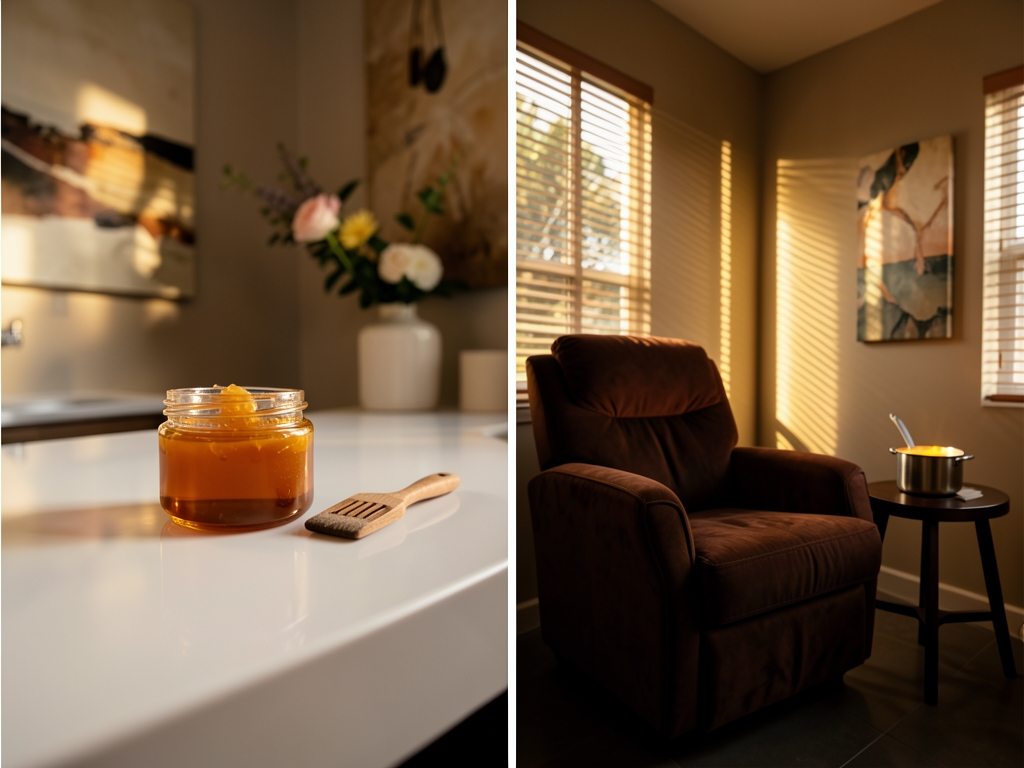
Check 40°C Before You Compare Waxes
Before you compare hard wax to soft wax, put a number on the pot. Hard wax goes on as a thicker, strip-free patch that lifts off on its own; soft wax is spread thinner and removed with cloth or paper strips. Different mechanics, same gate: both are only as safe as the measured temperature of the wax at the applicator. Wax type never substitutes for a thermometer reading, so the first comparison in any $60–$90 quote is not hard versus soft but verified versus unverified.
The myth to kill is that "40°C is exact when displayed." It isn't, because the label is a rounded figure. Vaia's textbook conversion of the heat-stroke threshold puts 105°F at approximately 40.56°C, or 313.71 K. That leaves a 0.56°C gap between the round 40°C target and the converted value, and a display that shows "40" can be hiding a reading above it. Ask to see the raw device display, not the rounded label on a spec sheet or a verbal "we keep it at forty."
The evidence converges on one rule: the number that matters is measured, not marketed. Vaia's 105°F conversion gives you the arithmetic ceiling; the sensor market data shows why instrumentation quality varies. MarkWide Research values the biomedical temperature sensors market at $3.8 billion as of 2026, on track for $8.05 billion by 2035 at 8.70% annual growth, and Dataintelo reports unit pricing from $0.30 for commodity thermistors to $2,000+ for specialized fiber optic assemblies. A spa's contact probe sits somewhere on that spectrum, which is exactly why you ask for the calibration record rather than assuming precision.
| Check | What to ask for | Pass condition |
|---|---|---|
| Target | Written 40°C service temperature | Stated in the service policy, not just spoken |
| Device | Device model and calibration record | Current record on file for the contact probe |
| Reading | Observed contact-probe reading at the pot or applicator | Raw display at or below 40°C |
| Protocol | Patch-test and redo policy | Written, with a defined redo path |

Hard vs Soft at the Same Verified Temp
The verdict table makes the cost signal explicit. A hard wax service at verified ≤40°C fits the $60–$90 quote as long as any mandatory add-ons—such as pre-wax antiseptic or post-wax soothing serum—remain inside the original quoted range. Soft wax at the same verified temperature is conditionally acceptable only if the client has previously tolerated strip removal without adverse reaction; otherwise, the conditional verdict shifts to “not recommended.” Any wax service performed without a verified ≤40°C reading, regardless of wax type, falls outside the defensible choice and should be avoided.
Split the $60-$90 Quote Into Line Items
Before you hand over a card at the counter, break the $60–$90 quote into written line items and confirm what is included. The base Brazilian service should be listed first, followed by any hard-wax upgrade, a patch-test if required, an aftercare kit, and a redo fee for missed spots. Each line must show whether it is included in the quoted price or billed separately, and the provider should state the exact dollar amount for each add-on. If the written list is vague—such as “premium wax” without a price—treat it as a red flag and request a revised worksheet before booking.
Use the worksheet to run a quick arithmetic check inside the $60–$90 range. If the base service is quoted at $60 and the hard-wax upgrade is listed at $15, the true total is $75. If an all-in quote is $90 with no add-on listed, the extra $15 must buy a documented protocol—such as a written temperature target, a calibration record, or an aftercare kit—not a vague “better wax.” Any quote where mandatory fees push the total above $90 should be rejected unless the provider removes a line item or provides written justification for the increase.
The worksheet also serves as your gatekeeper for the 40°C verification. As covered above, both hard and soft wax pass through the same gate: an observed contact-probe reading of ≤40°C, checked against the raw device display rather than a rounded label. Since the Vaia conversion puts the 105°F heat-stroke threshold at approximately 40.56°C, a provider claiming “just under 105°F” must still demonstrate a reading at or below 40°C before the wax-type comparison matters.
When the temperature is verified, the hard-vs-soft choice hinges on what you can tolerate before the service begins. Hard wax, applied as a thick strip-free patch that lifts off on its own, is the recommended choice for a first-time Brazilian client because it minimizes strip pull on sensitive skin. Soft wax is acceptable only if you have prior strip tolerance and the provider documents the same verified temperature. The worksheet should reflect this choice: if you select hard wax, the $15 add-on is justified; if you choose soft wax, the base price should remain unchanged unless an aftercare kit is explicitly included.
Finally, use the worksheet to confirm the redo policy. A first Brazilian often requires two passes, so ask whether a redo fee is waived if the temperature was verified and the patch-test was passed. If the provider cannot produce a written redo policy, book only if the total remains at or below $90 and the temperature gate is met. The MarkWide Research and Dataintelo sensor-market figures remind us that temperature verification is a technical requirement, not a marketing claim, so the worksheet is your only reliable tool to separate documented protocol from upsell.
What the 40°C and Cost Data Do Not Prove
The 40°C target and the $60–$90 quote are necessary inputs, but neither one proves the wax in the pot is actually at that temperature. A written protocol can be copied from a manufacturer's sheet without anyone ever checking the device against it, and a higher price can reflect rent, brand, or add-on services rather than tighter process control. Price does not prove calibration. Treat the quote as a budget constraint and the temperature as a separate, physical claim that has to be verified on the day.
Use the edge cases below as a decision table, not a menu. Each row names the condition that breaks the rule and the narrow circumstance in which the booking can still proceed.
| Edge case | Rule breaks? | Still wins if... |
|---|---|---|
| No written 40°C protocol | Breaks — do not book | N/A |
| Only IR surface gun, no contact probe | Breaks unless clinic shows calibration for that use | You see a contact-probe reading ≤40°C |
| Hard wax unavailable | Breaks for first-timer rule | You have prior soft-wax tolerance and same verified temp |
| Skin compromised or irritated | Breaks — postpone | Clinician clears and provider rechecks temp |
The infrared-gun row deserves emphasis because it is the most common substitution. A non-contact IR gun reads surface temperature and is sensitive to emissivity, distance, and angle; the MLX90614-style sensors used in biomedical instrumentation projects are built for specific target and field-of-view conditions, and a clinic using one for wax needs to show that its calibration covers that use. If the only reading offered is an IR surface number, ask for a contact-probe reading at or below 40°C before you undress. No contact reading, no booking.
The hard-wax-unavailable row is where first-timers get talked into a substitution. The first-Brazilian rule depends on hard wax's strip-free mechanics, so a soft-wax-only slot breaks it unless you already know you tolerate strips and the provider confirms the same verified temperature. "We ran out" is not a reason to change the plan on the day; reschedule instead.
Skin condition overrides everything else in the table. Compromised or irritated skin is a postponement, full stop, until a clinician clears it and the provider rechecks the pot temperature at the rescheduled visit. The cost of error here is not the $60–$90 fee; it is a burn or a tear on skin that was already compromised. The price band tells you what you can afford to spend, not what the wax is doing.
$75 Booking: Checkpoints and Cost of Error
A $75 booking sits at the midpoint of the $60–$90 quoted range, representing a first Brazilian wax where the provider commits to a verified ≤40°C service. To earn this rate, four checkpoints must pass in sequence: the written protocol must list a target ≤40°C; the device must be a calibrated contact probe with a documented calibration date; the observed pot or applicator reading must register ≤40°C before any wax touches skin; and a patch-test and redo policy must be provided in writing. If any checkpoint fails, the booking does not proceed at the $75 rate.
Hard wax is the defensible choice for a first-time Brazilian client only when the provider can produce a documented temperature log and a patch-test protocol. Hard wax is applied as a thick, strip-free patch that lifts off on its own, reducing the risk of skin trauma compared to strip-dependent removal. Soft wax may be used only if the client has demonstrated strip tolerance in a prior session at the same verified temperature; otherwise, the service defaults to hard wax to protect sensitive new skin.
The cost of an error runs both ways. If the provider cannot produce the required documentation or an observed contact-probe reading ≤40°C, you should not book at all — do not pay the quoted price for a service that fails the temperature gate. Conversely, if a redo is needed after a verified service, the redo fee must come from the written redo policy you requested at booking, not from a number invented on the day. Ask for that exact dollar amount in writing before you hand over a card, and treat any undocumented redo charge as a reason to walk away.
Before any wax type is selected, the reader must secure an observed contact-probe reading ≤40°C. Only then does the $75 booking lock in, and only then does the hard-versus-soft decision hinge on client tolerance and prior strip experience. This checkpoint-first sequence ensures the temperature gate is cleared before cost or wax-style trade-offs are considered.
Worked Example: Run the Numbers
Here is one worked example, end to end, using only the inputs a reader can verify at booking. Scenario: a first-time Brazilian client in 2026, quoted $75 for the service, comparing two providers who both claim a "low-temperature" wax. Provider A offers hard wax at a stated 40°C target; Provider B offers soft wax at the same stated target. The client has no prior strip-wax history. All figures below are an illustration of the method, not a market average.
Next, apply the reader rule to the client profile. With no prior strip tolerance, the rule points to hard wax: it lifts off on its own and does not depend on the client having tolerated cloth or paper strips before. Soft wax is acceptable here only if the client already has documented strip tolerance at the same verified temperature. In this example, that condition is absent, so Provider A (hard wax) is the defensible pick and Provider B is the fallback only if the client later establishes strip tolerance.
Step 3 — run the cost check on the $75 quote. Using the line-item worksheet method, separate the base service from any hard-wax add-on and any patch-test or redo charge. Illustration: if Provider A's $75 includes a $15 hard-wax add-on, the base service is $60 and the add-on is $15, summing back to $75. If Provider B's $75 is all-inclusive soft wax with no add-on, the two quotes are not directly comparable until both are broken into the same line items.
| Step | Check | Illustration |
|---|---|---|
| Gate | Observed contact-probe ≤40°C | Both providers pass (assumed) |
| Wax type | First Brazilian, no strip history | Hard wax (Provider A) |
| Cost split | Base + add-on | $60 + $15 = $75 |
| Winner | Verified temp + hard wax | Provider A |
| Break-even | B below A's base + add-on, with strip tolerance | Soft wax only then |
If/Then Rules for a $60-$90 Wax
Start with paper. If the provider cannot show a written 40°C target and a calibration date for the wax warmer, do not book at any price in the $60-$90 range — an unstated target is an unverifiable one, and a warmer with no calibration date has no claim to any temperature. If there is no written patch-test and redo policy, treat the temperature claim as unverified and walk away for the same reason: a number you cannot hold the provider to is not a control, it is a courtesy.
Then check the wax itself, not the brochure. If the observed contact-probe reading sits above 40°C, decline the service regardless of price or wax type; you book only when that observed reading is at or below 40°C. If the reading clears the gate and this is your first Brazilian, choose hard wax. If you already tolerate soft wax at that same verified temperature, soft wax is acceptable — prior tolerance, not the size of the quote, is what makes the softer option defensible.
Only after the gates clear do you compare money. If the $60 base becomes a $75 true total once a mandatory hard-wax fee is added, set that $75 against the $90 all-in quote and pick the one backed by the written protocol, not the lower base. The $75 is the smaller number on the sheet; if it is also the one without documentation, it is the wrong buy, because the true total you are protecting against is a redo you did not agree to.
Frequently Asked Questions
What must a provider document before a first Brazilian wax with hard wax can be recommended?
the temperature and patch-test protocol
Under what condition can soft wax be used for a Brazilian wax?
only with prior strip tolerance at the same verified temperature
What must a reader verify regarding the temperature device before booking a Brazilian wax?
the device and its calibration record
What is the defensible choice for a 2026 Brazilian wax quoted at $60-$90 if the provider cannot show a written 40°C target, device/calibration record, and patch-test/redo policy?
the choice flips to soft wax only after prior strip tolerance, or avoid booking
Also worth reading: Comparing 6 Popular Thai Curry Types A Detailed Calorie and Macronutrient Breakdown: Comparing 6 Popular Thai Curry · The Science Behind the Perfect Chicken Cheesesteak Temperature, Texture, and Taste: Science Behind the Perfect Chicken · The Science Behind Air-Fried Tortilla Chips Temperature and Timing for Perfect Crispiness: Science Behind Air-Fried Tortilla Chips